How Frame Straightening Works, and How to Tell Yours Has Moved
A car can look fine after a hard hit and still sit a few millimeters off, and the road will tell you before the paint does.
October 14, 2026 · 4 min read
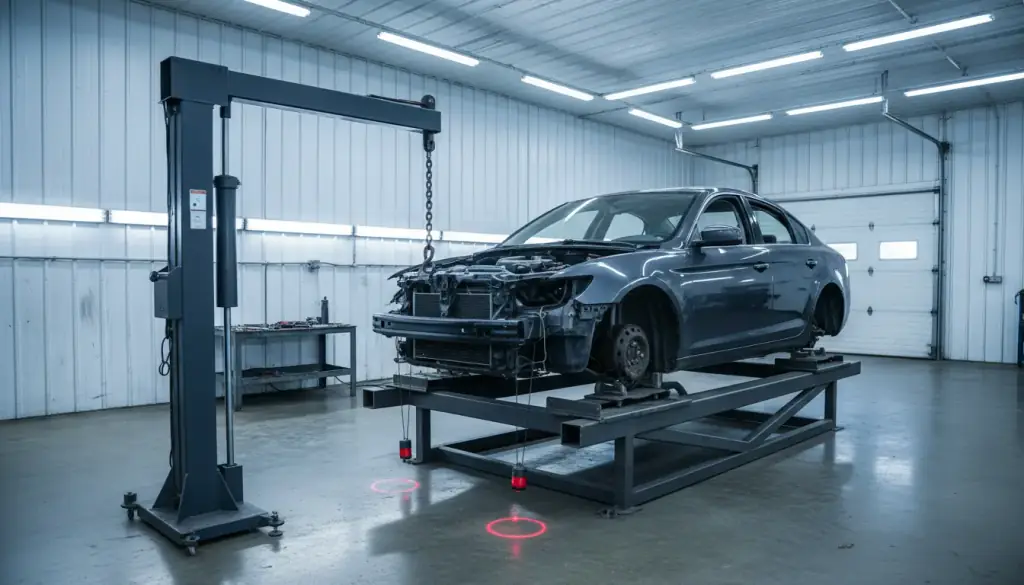
When a wreck is bad enough to bend the structure under the body panels, it stops being a cosmetic problem. The frame, or the unibody on most modern cars, is what everything else bolts to. The suspension, the engine mounts, the doors and the crumple zones all depend on it being where the factory put it. If it moves even slightly, the car can pull, wear tires unevenly, and absorb the next impact differently than it was designed to.
Frame or unibody, same idea
Older trucks and some SUVs ride on a separate steel frame, a ladder-shaped chassis with the body mounted on top. Most cars and crossovers use a unibody, where the structure is built into the body shell itself. The tools differ a little, but the principle is the same. There is a set of factory dimensions, and a straightened car has to come back to them.
Signs your frame may have moved
After an accident, damage can hide behind panels that look straight. Here are signs that deserve a closer look, even if the car appears to have survived.
- The car pulls to one side on a flat, straight road
- The steering wheel sits off-center when you're driving straight
- Uneven or fast tire wear that wasn't there before
- Doors, the hood or the trunk that rub, stick or won't line up
- Uneven gaps between panels, wider on one side than the other
- A new squeak, rattle or wind noise after the hit
- Visible creases or kinks in the metal under the car or in the trunk floor
None of those proves the frame is bent, but together or alone they justify having the car measured. An alignment alone can't fix a car whose mounting points have moved, because the alignment machine can only adjust what's attached to a structure that isn't where it should be.
Measurement comes first
Laser measurement is how a shop learns the truth. Targets are attached at known points on the car, and the system reads where each one sits in three dimensions. Those readings are compared against the manufacturer's specifications for that exact vehicle. The difference tells the technician how far each point has moved and in which direction.
This matters because the eye is a poor measuring tool. A shift of a few millimeters is easy to miss by looking and easy to feel at 70 miles an hour. Ron Kirk's Body Shop does frame straightening with laser measurement, so you start with numbers, not with a guess.
The machine and the pulls
The car is secured to the frame-adjustment machine so it can't shift while force is applied. Then the technician sets up high-strength hydraulic machinery, with chains and clamps attached at chosen points, and pulls against the direction of the damage. The idea is to reverse the impact, in the opposite direction from how the force came in, and in small steps.
Metal has memory, and it doesn't like to be rushed. A technician pulls a little, relaxes, measures again, and pulls again. Overpulling can stretch and weaken the metal, so the careful approach is to approach the factory dimension gradually and let the numbers say when to stop. The goal is restoring the car to its original shape and condition, with the measurements to prove it.
How long frame work takes
Frame work is not something to hurry, but it also doesn't have to take weeks. Ron Kirk's Body Shop says it can complete frame services within 2 to 3 days, and it offers same-day estimates, so you aren't waiting around to find out what you're facing. Actual time depends on how bad the damage is and what has to be replaced along the way, and an honest shop will tell you when that changes.
The shop's collision work runs from small dents to major frame work, on foreign and domestic vehicles alike, so a car that needs the frame pulled and the panels painted can stay in one place. The painting is done in an onsite spray booth after the structure is right, which is the correct order. Paint over an unfinished structure is just a nice-looking mistake.
What to ask before you commit
- Will the car be measured before and after, and can I see the readings?
- What parts will need to be replaced instead of pulled?
- How long will it take, and what could change that?
- Is an alignment part of the finishing work?
Good shops welcome those questions, since the answers are part of the job. After the repair, expect a test drive that tells you the same thing the measurements do: the car tracks straight, the wheel sits level, and the doors close with a normal sound.
If you've been in an accident and something feels off, get it measured. It is better to find out now than at the next set of tires. The estimate is free and can happen the same day. Ron Kirk's Body Shop is at 501 Vermont Ave in Holton, open weekdays 8:00 am to 5:00 pm, and the number is (785) 364-2931.
Ron Kirk's Body Shop, (785) 364-2931
Call (785) 364-2931More articles
The First Hour After a Deer or Bird Strike on a Kansas Highway
Most of what matters happens in the first sixty minutes, and very little of it has to do with the car.
Windshield Chip or Crack: Repair It or Replace the Glass?
Size matters, but so do location and age, and the clock starts the moment the rock lands.